Corporate Travel Audit Guide: Improve Cost Control, Compliance and Visibility
Corporate travel is often treated as a booking function. A flight is booked, a hotel is confirmed, a cab is arranged, and the trip moves forward.
But for growing businesses, travel is much more than a set of reservations. It is a recurring operational cost, a compliance requirement, a traveller experience factor, and in many cases, a direct contributor to business growth.
That is why a corporate travel audit is important.
A travel audit helps companies understand whether their travel policy, booking process, vendor usage, approval system, expense documentation, GST records, forex handling, and reporting structure are working together effectively.
The objective is not only to reduce cost. The objective is to create better control, better visibility, and better decision-making across every business trip.
What Is a Corporate Travel Audit?
A corporate travel audit is a structured review of how business travel is planned, approved, booked, paid for, documented, and reported.
It helps companies answer important questions such as:
- Are employees following the travel policy?
- Are bookings being made through approved channels?
- Are costs being tracked by department, project, branch, or business unit?
- Are invoices and GST details correctly captured?
- Are forex, visa, insurance, and ground transport being managed with proper documentation?
- Are preferred vendors actually delivering value?
- Are exceptions being approved properly?
- Are travellers getting the support they need?
When these questions are reviewed regularly, travel management becomes less reactive and more strategic.
The Business Impact of Not Auditing Corporate Travel
When corporate travel is not audited regularly, small gaps can become expensive patterns.
A few last-minute flight bookings, repeated out-of-policy hotel stays, duplicate reimbursements, missed GST documentation, unclear approval trails, or fragmented vendor usage may not seem significant individually. But over time, these issues can directly affect budgets, compliance, employee productivity, and management visibility.
For finance teams, unaudited travel can lead to poor cost forecasting, delayed reimbursements, missed tax documentation, and limited spend control.
For HR and admin teams, it can create employee dissatisfaction, repeated follow-ups, unclear travel communication, and avoidable escalations.
For procurement teams, it can weaken vendor negotiations because travel data is scattered across multiple channels.
For leadership teams, it can limit the ability to understand where travel money is going, which departments are driving spend, and whether travel is generating the expected business value.
Industry data also shows why structured travel control is becoming more important. GBTA forecasts Asia Pacific business travel spending to reach USD 700.9 billion in 2026, reflecting the scale of corporate travel activity across the region. SAP Concur’s business spending research also found that 64% of employees had seen an increased focus on pre-travel approval, showing how organisations are placing more attention on approval-led control.
In simple terms, if corporate travel is not audited, companies may continue spending without fully understanding the reasons, patterns, exceptions, or opportunities for savings.
Why Corporate Travel Audits Matter for Cost Control

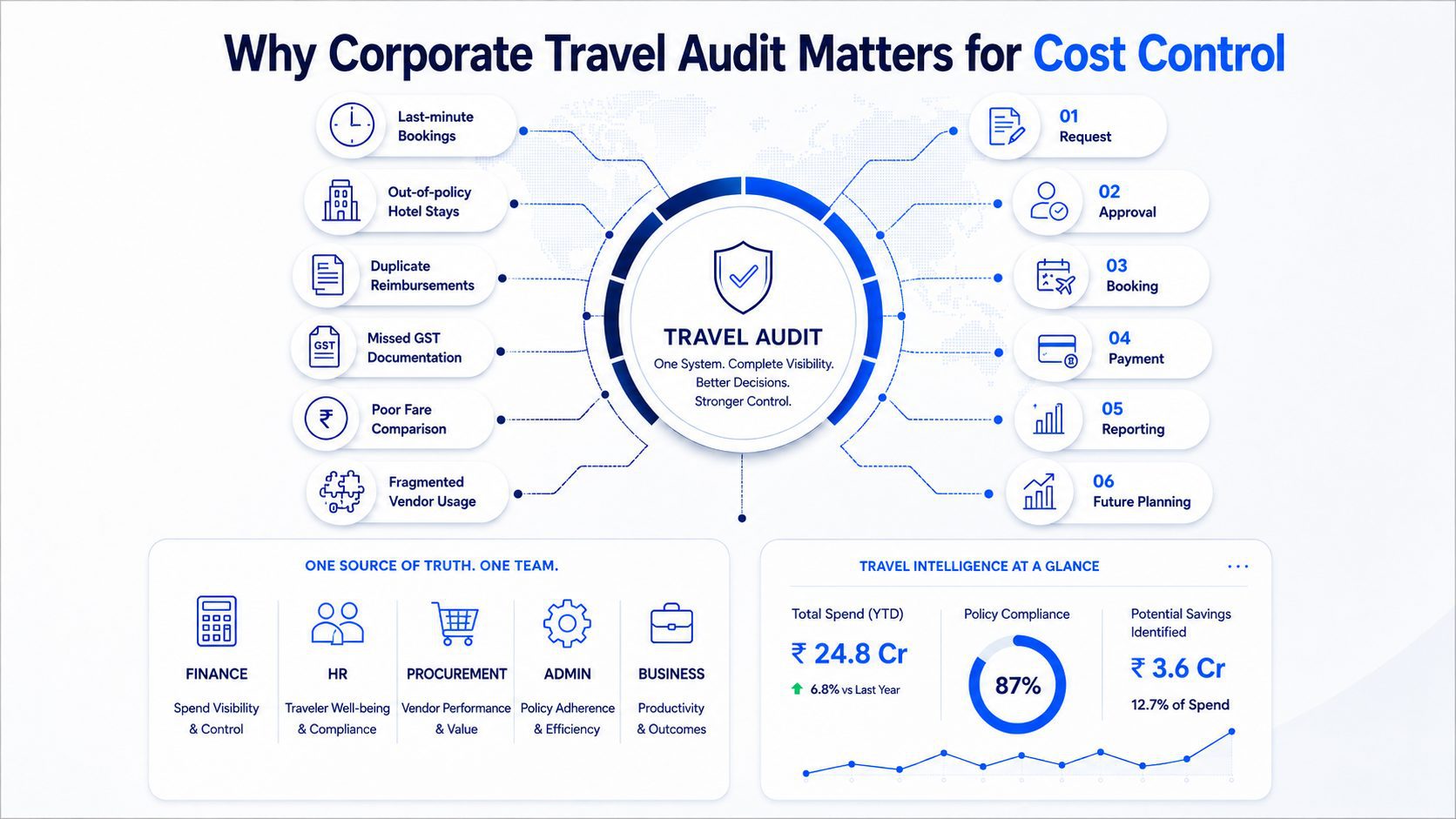
Travel costs can increase quietly. A few last-minute bookings, repeated out-of-policy hotel stays, duplicate reimbursements, missed GST documentation, poor fare comparison, or fragmented vendor usage may not seem significant individually. But over time, they can create a major impact on the travel budget.
A travel audit helps identify these leakages before they become normal practice.
It also helps finance, HR, procurement, admin, and business teams work from the same data. Instead of looking only at post-trip expenses, companies can review the complete travel journey from request to approval, booking to payment, and reporting to future planning.
Step 1: Review the Current Travel Policy
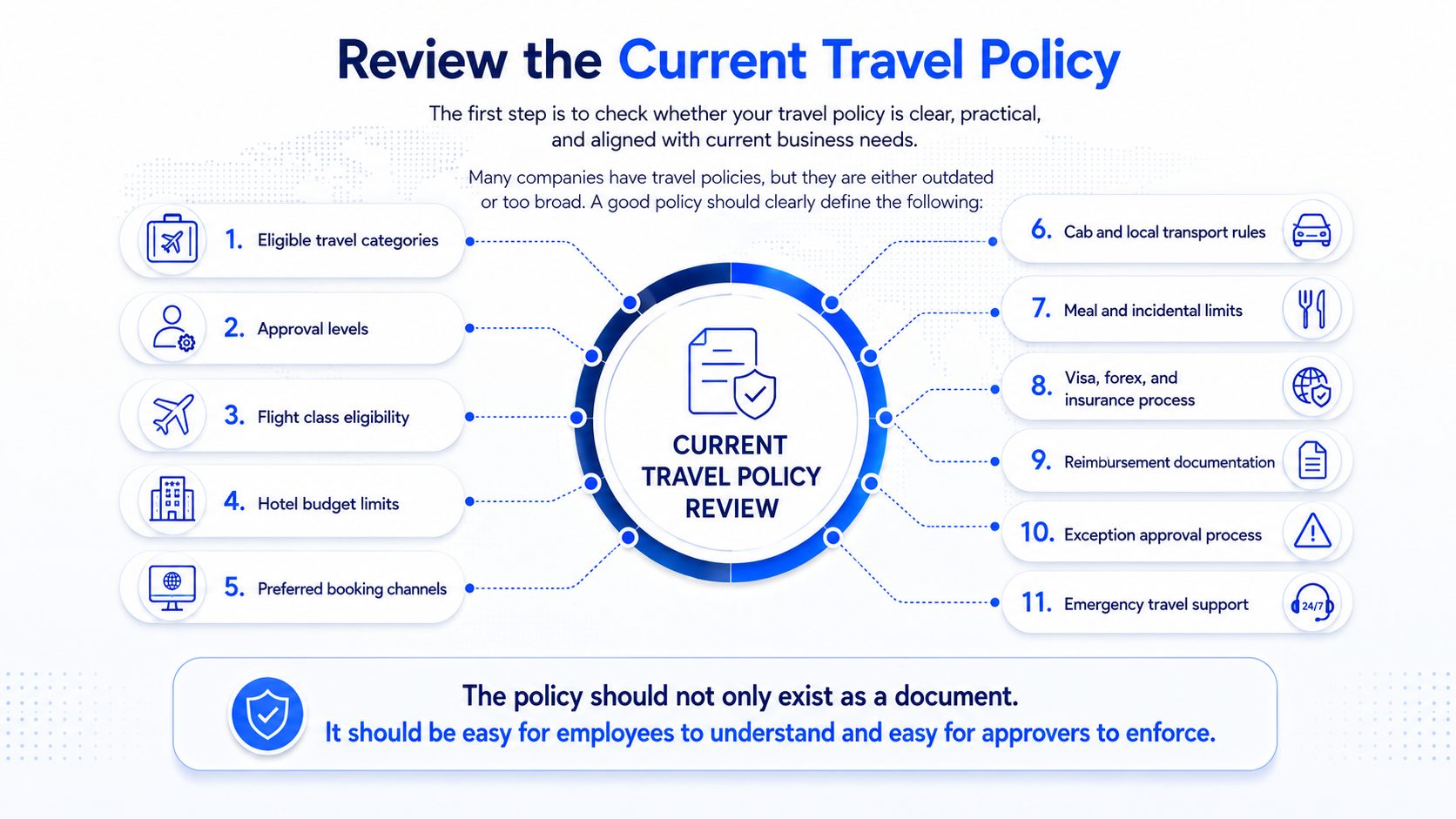
The first step is to check whether your travel policy is clear, practical, and aligned with current business needs.
Many companies have travel policies, but they are either outdated or too broad. A good policy should clearly define:
- Eligible travel categories
- Approval levels
- Flight class eligibility
- Hotel budget limits
- Preferred booking channels
- Cab and local transport rules
- Meal and incidental limits
- Visa, forex, and insurance process
- Reimbursement documentation
- Exception approval process
- Emergency travel support
The policy should not only exist as a document. It should be easy for employees to understand and easy for approvers to enforce.
Companies can also review whether their policy supports today’s business travel requirements such as domestic travel, international travel, client visits, project travel, leadership travel, MICE movements, and emergency changes.
Step 2: Check Booking Behaviour
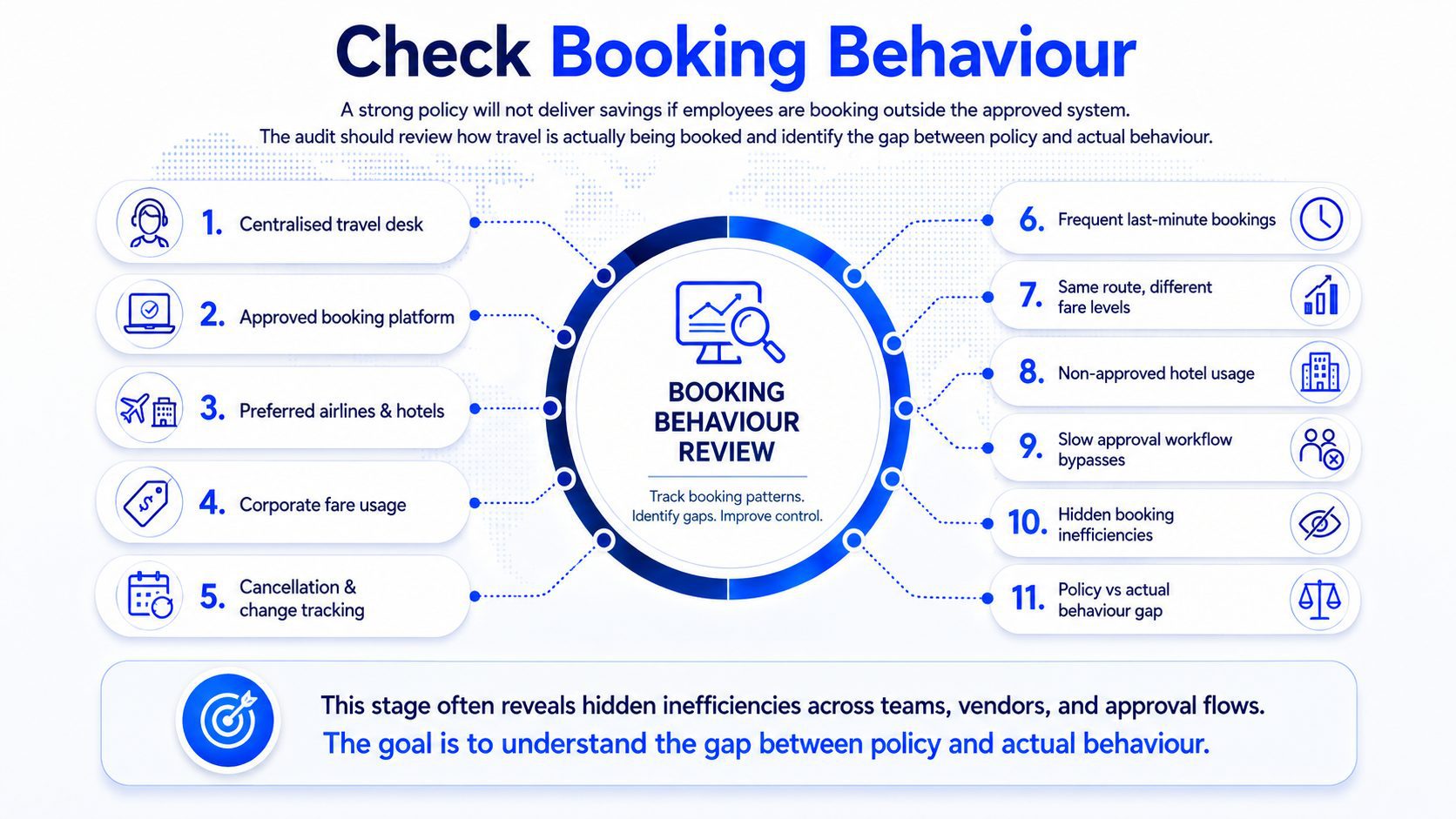
A strong policy will not deliver savings if employees are booking outside the approved system.
The audit should review how travel is actually being booked.
Are employees booking through a centralised travel desk or approved platform? Are they choosing preferred airlines, hotels, and corporate rates? Are last-minute bookings happening too often? Are cancellations and changes being tracked?
This stage often reveals hidden inefficiencies. For example, different teams may be booking the same route at different fare levels. Some employees may be using non-approved hotels. Some departments may be bypassing approval workflows because the current process is too slow.
The goal is to understand the gap between policy and actual behaviour.
For organisations looking to centralise bookings and improve visibility, a structured corporate travel management model can help bring requests, bookings, approvals, and reporting into one managed process. This is especially useful when flight bookings are handled through a dedicated corporate air ticketing process instead of scattered individual bookings.
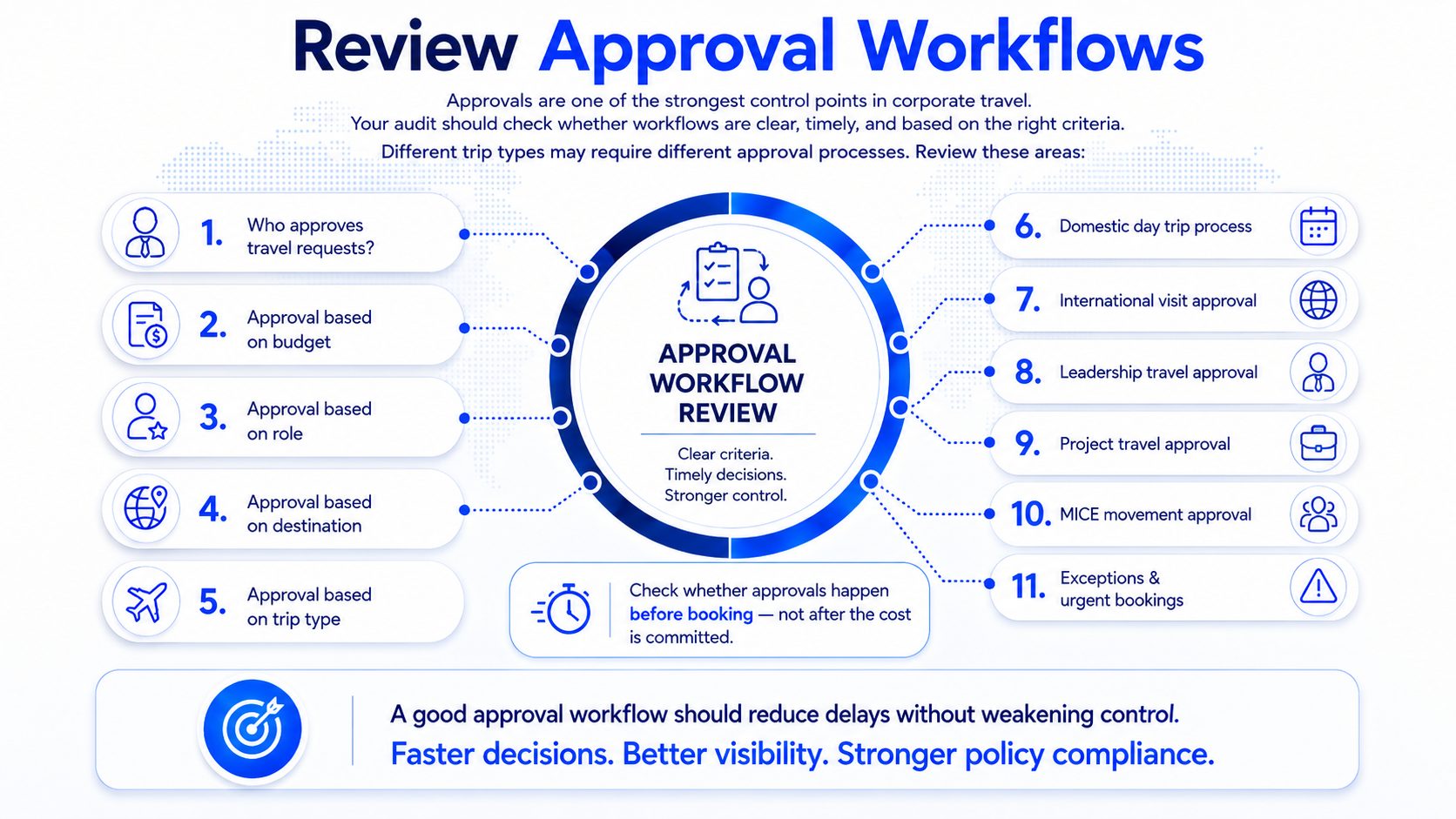
Step 3: Review Approval Workflows
Approvals are one of the strongest control points in corporate travel.
Your audit should check whether approval workflows are clear, timely, and based on the right criteria. A simple domestic day trip may need a different approval process than an international business visit, leadership travel, project travel, or MICE movement.
Review these areas:
- Who approves travel requests?
- Are approvals based on budget, role, destination, or trip type?
- Are exceptions documented?
- Are urgent bookings handled with proper controls?
- Are approvals happening before booking or after the cost is already committed?
A good approval workflow should reduce delays without weakening control.
When approval data is tracked properly, companies can also identify repeated exceptions, frequent last-minute requests, and departments where travel planning needs improvement.
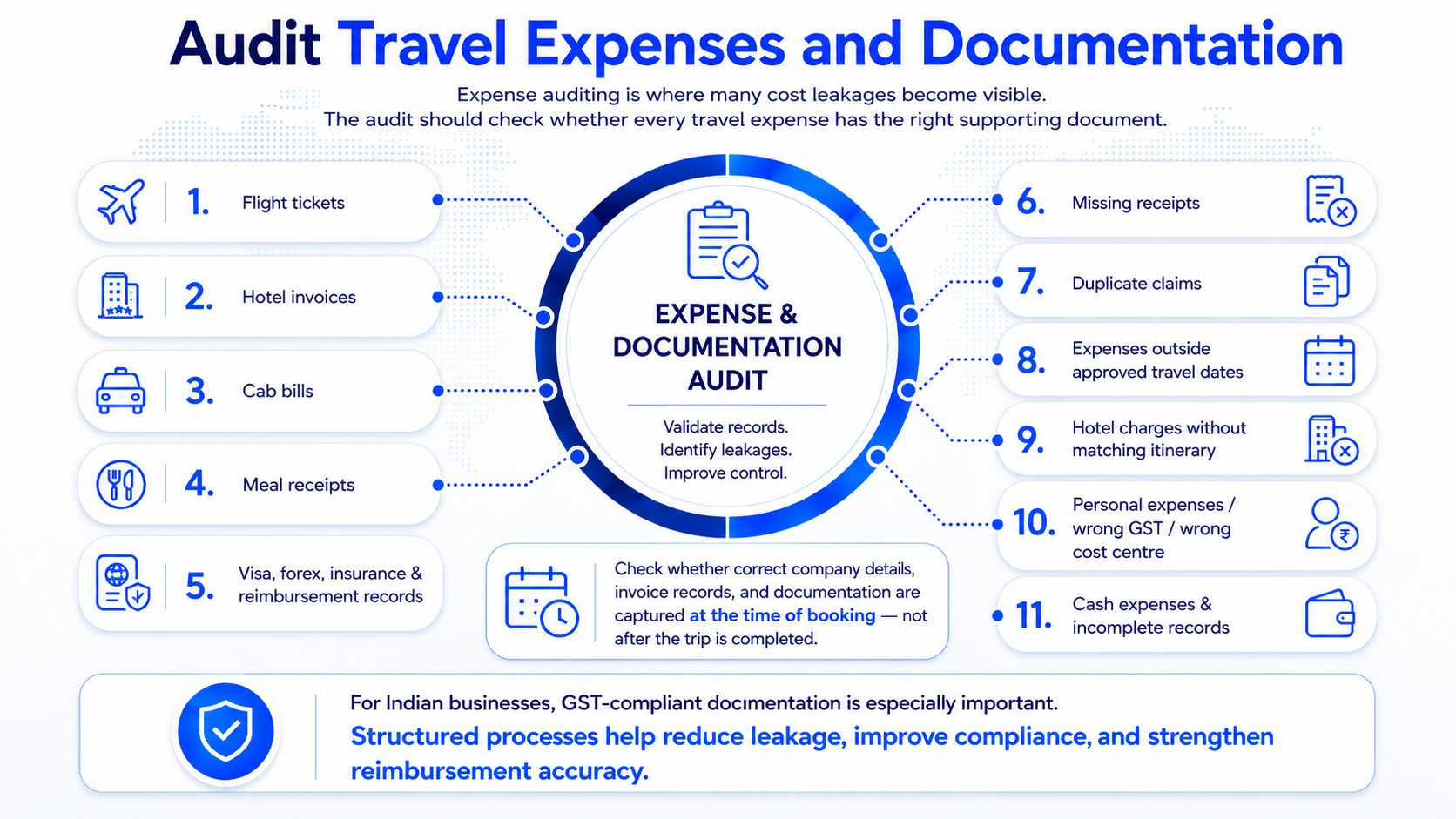
Step 4: Audit Travel Expenses and Documentation
Expense auditing is where many cost leakages become visible.
The audit should check whether every travel expense has the right supporting document. This includes flight tickets, hotel invoices, cab bills, meal receipts, visa charges, forex documentation, travel insurance records, and reimbursement claims.
Important checks include:
- Missing receipts
- Duplicate claims
- Expenses outside approved travel dates
- Hotel charges without matching business itinerary
- Personal expenses added to business travel
- Incorrect GST details
- Claims submitted under the wrong department or cost centre
- Cash expenses without sufficient explanation
- Incomplete reimbursement records
For Indian businesses, GST-compliant documentation is especially important. A structured corporate travel process should help ensure correct company details, invoice records, and documentation are captured at the time of booking, not after the trip is completed.
This is where clear reporting and GST-ready documentation can help finance teams reduce manual follow-ups and improve audit readiness.
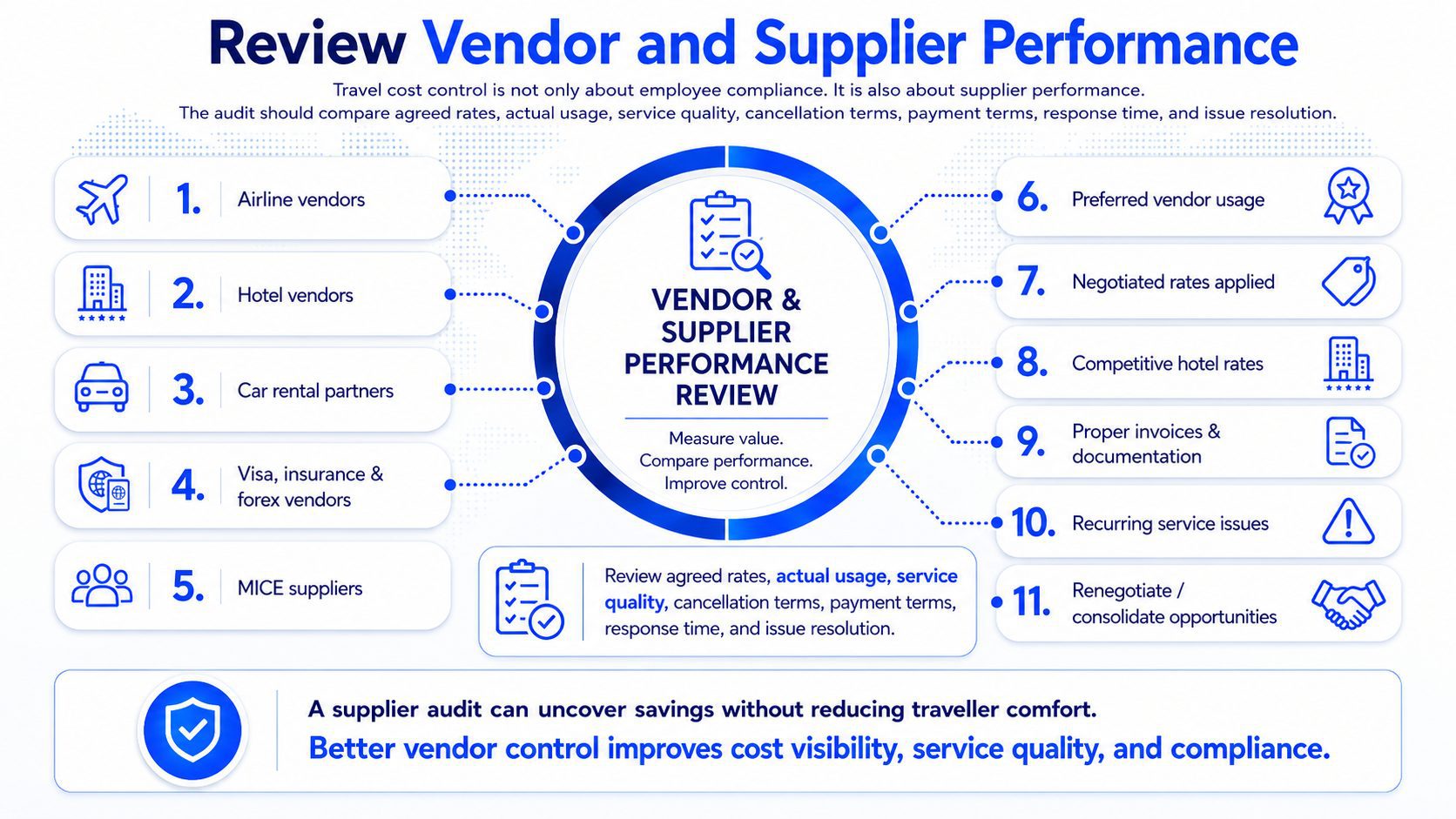
Step 5: Review Vendor and Supplier Performance
Travel cost control is not only about employee compliance. It is also about supplier performance.
Companies should review whether their airline, hotel, car rental, visa, insurance, forex, and MICE vendors are delivering value. The audit should compare agreed rates, actual usage, service quality, cancellation terms, payment terms, response time, and issue resolution.
Key questions to ask:
- Are preferred vendors being used?
- Are negotiated rates actually being applied?
- Are hotel rates competitive across key business destinations?
- Are vendors providing proper invoices and documentation?
- Are service issues recurring?
- Are there opportunities to renegotiate rates or consolidate suppliers?
A supplier audit can uncover savings without reducing traveller comfort.
For example, if hotel usage is fragmented across many booking channels, companies may lose negotiated-rate benefits. Reviewing accommodation data can help identify where preferred hotel programmes, corporate rates, or a managed corporate accommodation process can improve cost control.
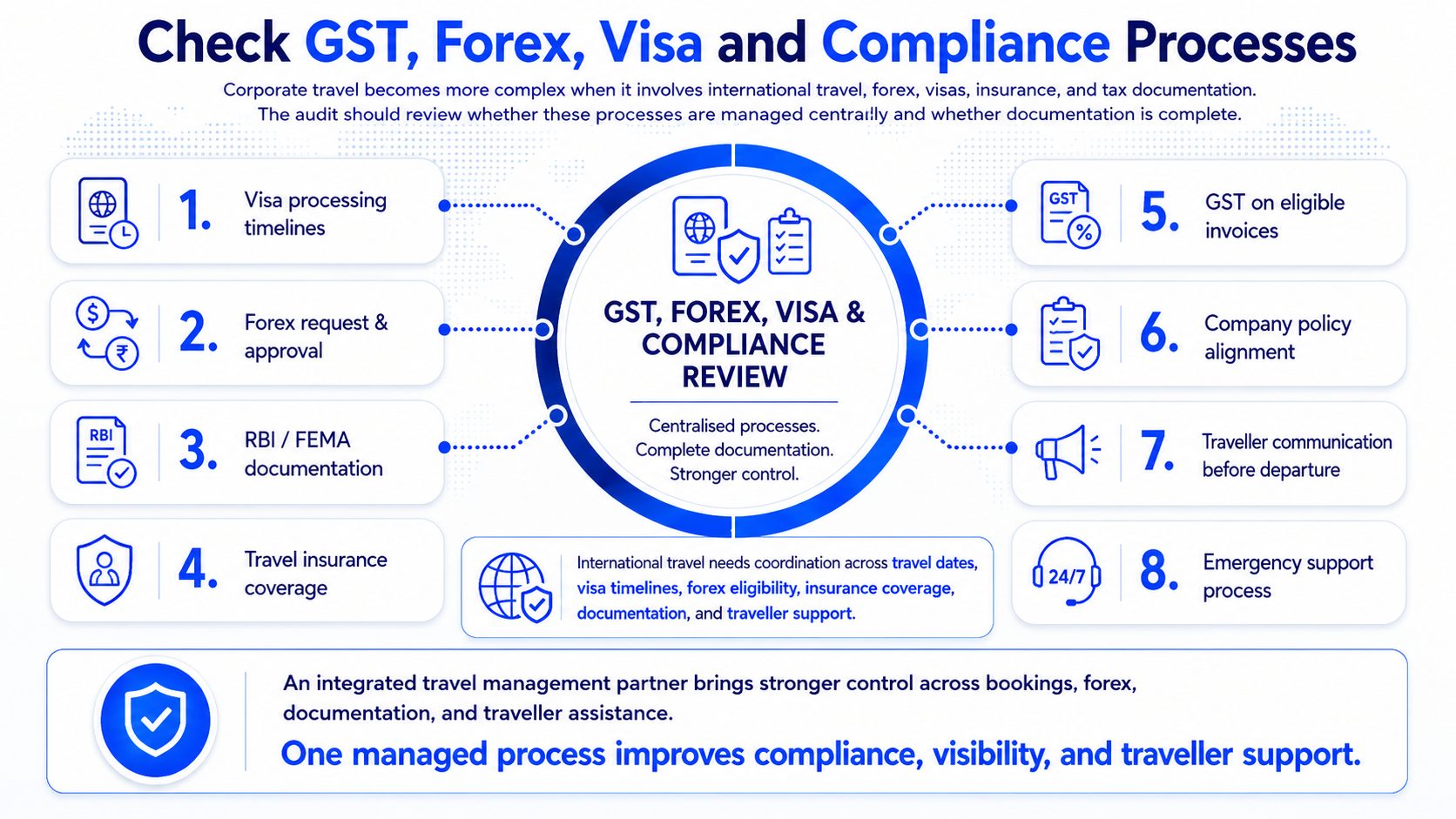
Step 6: Check GST, Forex, Visa and Compliance Processes
Corporate travel becomes more complex when it involves international travel, forex, visas, insurance, and tax documentation.
The audit should review whether these processes are being managed centrally and whether documentation is complete. International travel should not be handled only as a ticketing requirement. It needs coordination across travel dates, visa timelines, forex eligibility, travel insurance coverage, documentation, and traveller support.
Review:
- Visa processing timelines
- Forex request and approval process
- RBI and FEMA-related documentation where applicable
- Travel insurance coverage
- GST details on eligible invoices
- Company policy alignment
- Traveller communication before departure
- Emergency support process
This is where an integrated travel management partner can bring stronger control because bookings, forex, documentation, and traveller assistance can be connected under one managed process.
When these areas are reviewed together, companies are better positioned to reduce compliance gaps and avoid last-minute travel disruptions.
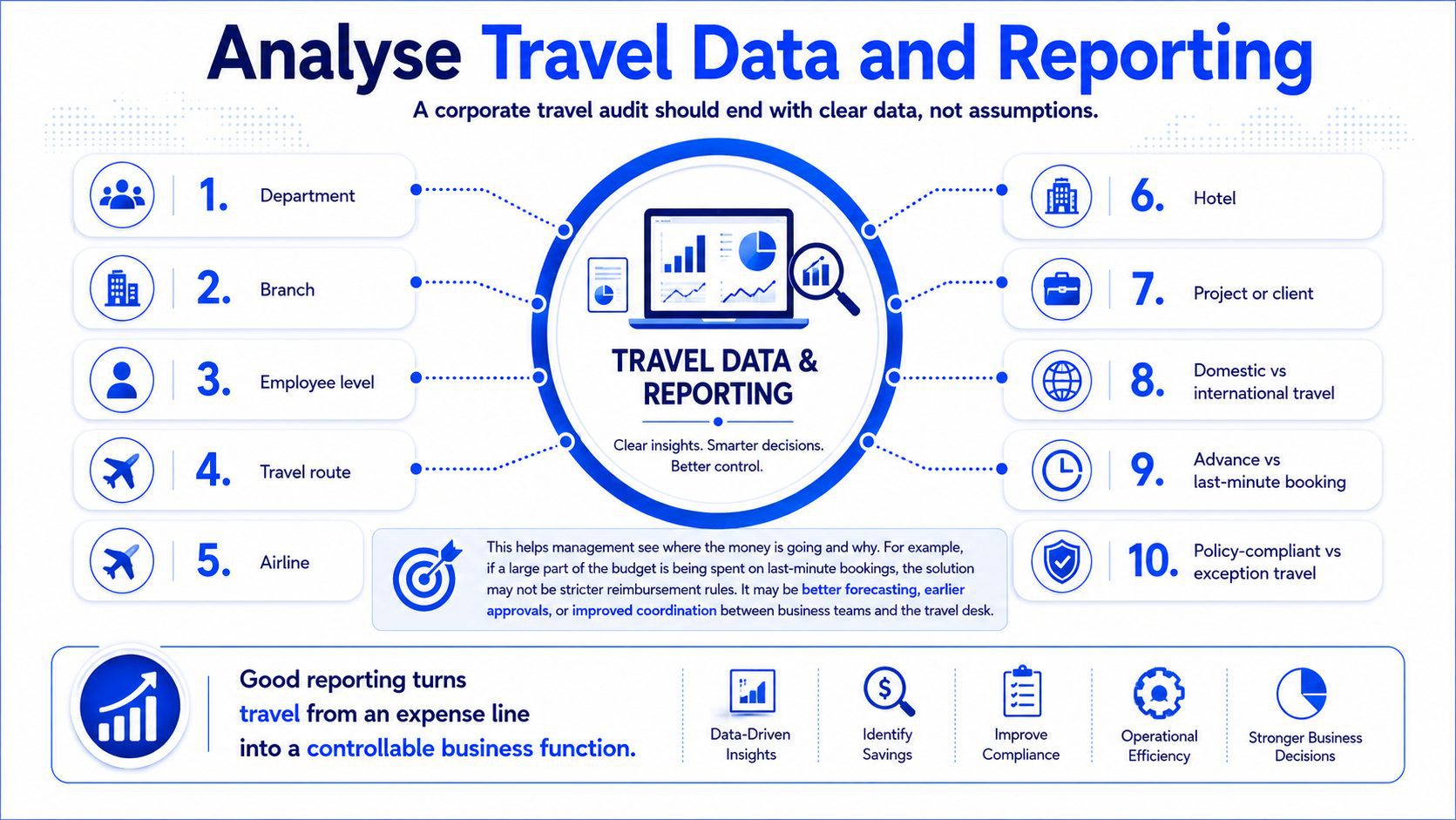
Step 7: Analyse Travel Data and Reporting
A corporate travel audit should end with clear data, not assumptions.
Companies should review spend by:
- Department
- Branch
- Employee level
- Travel route
- Airline
- Hotel
- Project or client
- Domestic vs international travel
- Advance vs last-minute booking
- Policy-compliant vs exception travel
This helps management see where the money is going and why.
For example, if a large part of the budget is being spent on last-minute bookings, the solution may not be stricter reimbursement rules. It may be better forecasting, earlier approvals, or improved coordination between business teams and the travel desk.
Good reporting turns travel from an expense line into a controllable business function.
A well-managed travel programme should give finance, HR, admin, procurement, and leadership teams access to meaningful reports that support better decisions.
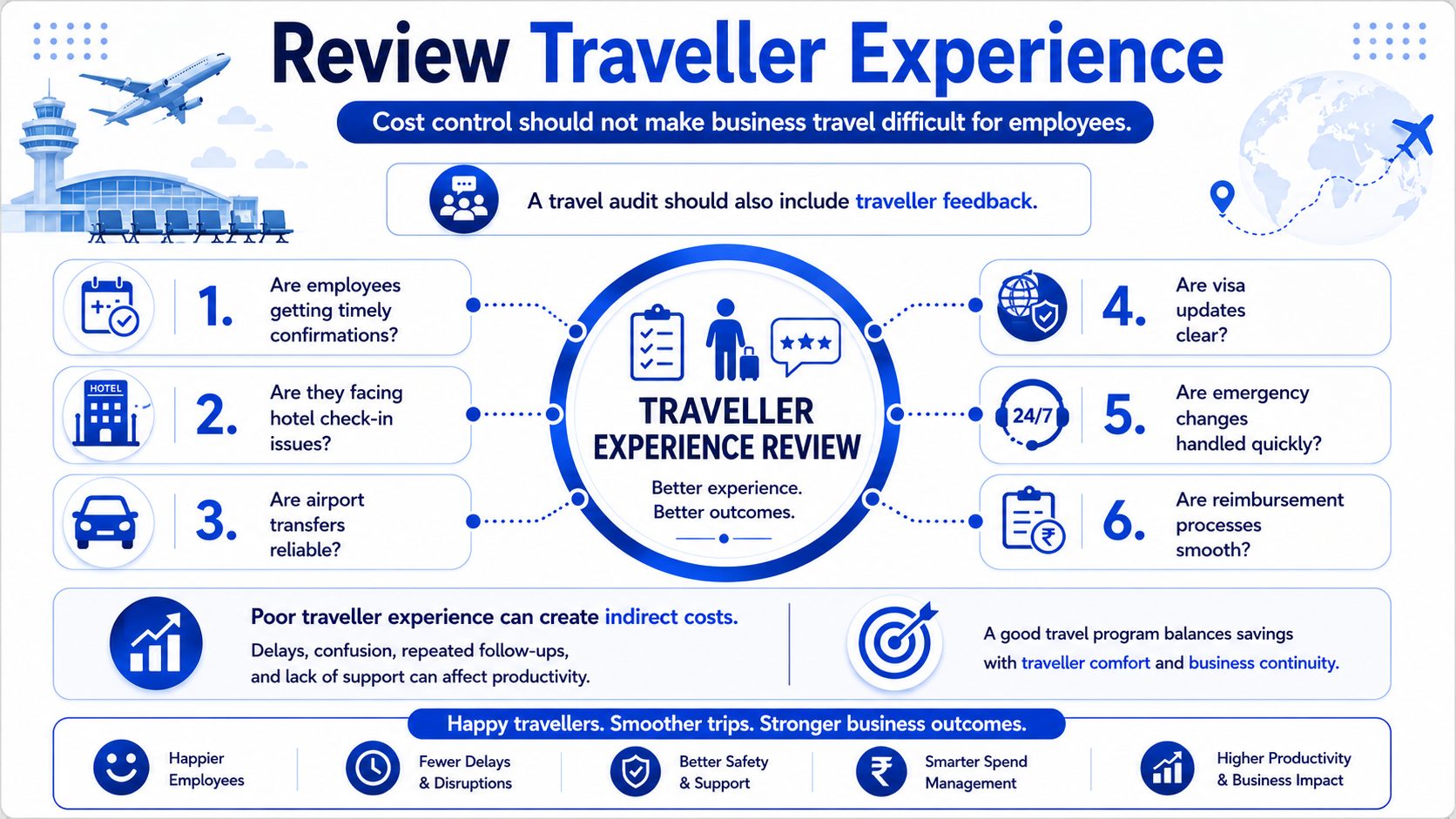
Step 8: Review Traveller Experience
Cost control should not make business travel difficult for employees.
A travel audit should also include traveller feedback.
Are employees getting timely confirmations? Are they facing hotel check-in issues? Are airport transfers reliable? Are visa updates clear? Are emergency changes handled quickly? Are reimbursement processes smooth?
Poor traveller experience can create indirect costs. Delays, confusion, repeated follow-ups, and lack of support can affect productivity.
A good travel programme balances savings with traveller comfort and business continuity.
When traveller experience is reviewed along with cost and compliance, companies can create a travel process that is efficient for the organisation and practical for employees.
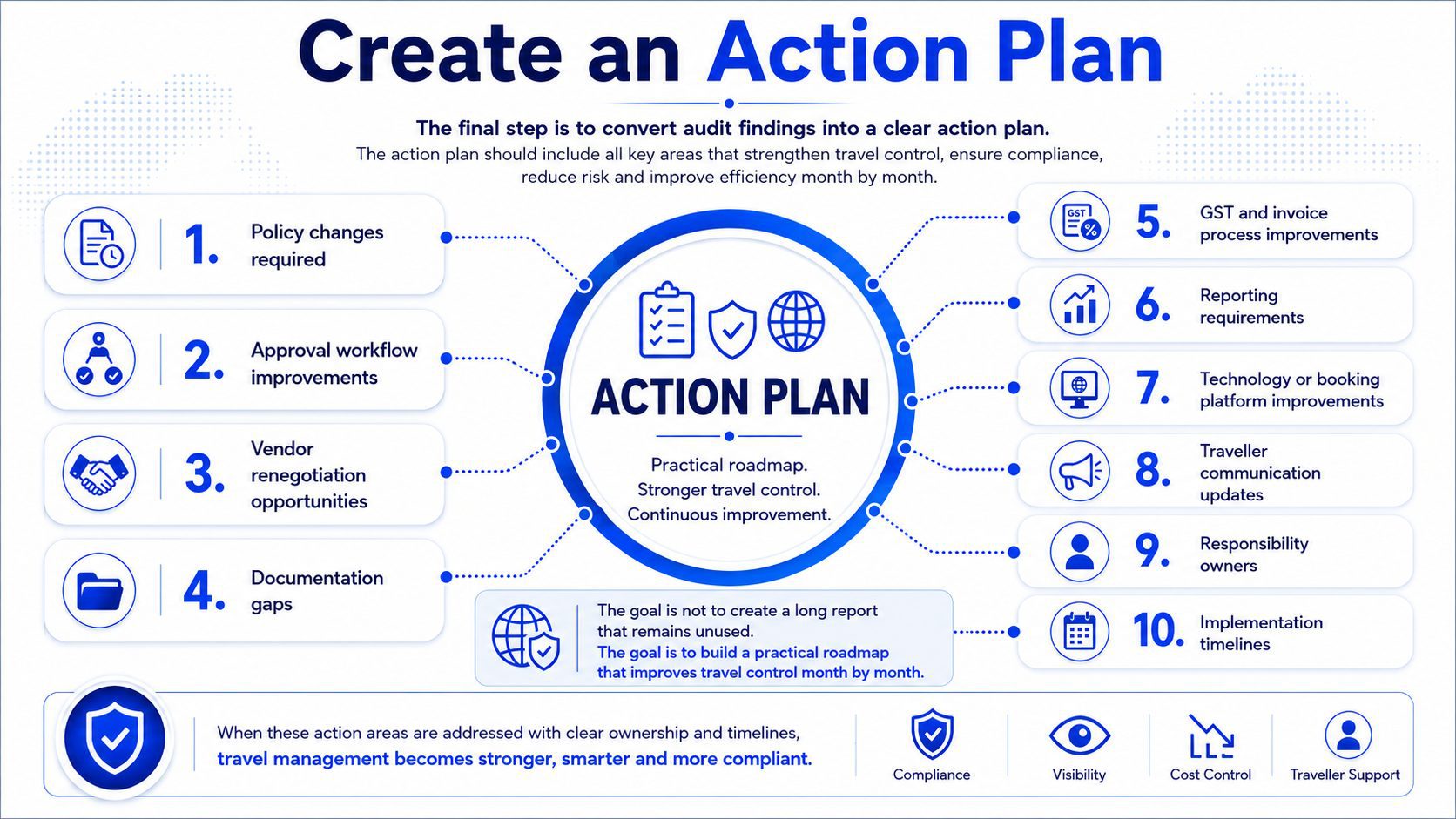
Step 9: Create an Action Plan
The final step is to convert audit findings into a clear action plan.
The action plan should include:
- Policy changes required
- Approval workflow improvements
- Vendor renegotiation opportunities
- Documentation gaps
- GST and invoice process improvements
- Reporting requirements
- Technology or booking platform improvements
- Traveller communication updates
- Responsibility owners
- Implementation timelines
The goal is not to create a long report that remains unused. The goal is to build a practical roadmap that improves travel control month by month.
Each action should be linked to a business outcome such as lower last-minute booking costs, better policy compliance, faster approvals, improved GST documentation, better vendor performance, or stronger traveller support.
How Often Should Companies Audit Corporate Travel?
A full corporate travel audit can be done annually. However, high-travel organisations should review key reports every quarter.
Companies should also consider an audit when:
- Travel spend is increasing without clear visibility
- Employees are frequently booking outside policy
- Reimbursements are delayed or disputed
- GST documentation gaps are recurring
- New branches or teams are added
- International travel volume increases
- Vendor contracts are outdated
- The business is shifting from manual travel handling to a managed travel system
Regular reviews help prevent small issues from becoming expensive patterns.
How Gilpin Travel Management Supports Better Travel Control
A corporate travel audit becomes more effective when organisations can see the full travel picture clearly.
Gilpin Travel Management helps companies move from fragmented travel handling to a more structured, visible, and accountable travel management process.
Instead of looking at bookings, approvals, documentation, forex, visas, accommodation, ground transport, MICE movements, and reporting as separate activities, Gilpin helps bring these elements into a connected travel ecosystem.
This gives organisations stronger control across four important areas:
1. Visibility
When travel is handled through multiple channels, finance and admin teams often struggle to see the complete cost picture. Gilpin helps companies create better visibility across bookings, routes, departments, vendors, invoices, and traveller requirements.
This makes it easier to understand where travel spend is going and where cost leakages may exist.
2. Compliance
A structured travel process helps ensure that bookings, approvals, documentation, GST records, visa support, forex requirements, and traveller communication are aligned with company policy.
This reduces exceptions, manual follow-ups, and compliance gaps.
3. Reporting
Good reporting allows companies to make better decisions.
Gilpin supports businesses with dashboards, booking insights, documentation visibility, and travel data that can help teams analyse spend patterns, supplier performance, last-minute booking behaviour, and policy adherence.
4. Cost Control
Cost control does not only come from choosing the lowest fare. It comes from better planning, stronger approval workflows, negotiated supplier usage, reduced fragmentation, GST-ready documentation, and actionable reporting.
By helping companies connect travel operations under one managed framework, Gilpin enables finance, HR, admin, procurement, and business teams to manage travel more strategically.
Organisations can also explore Gilpin’s wider capabilities across corporate air ticketing, corporate accommodation, visa, forex, travel insurance, GST documentation, and MICE travel management to build a more integrated travel programme.
Conclusion
A corporate travel audit is not only a finance exercise. It is a business control exercise.
It helps companies understand whether their travel policy is working, whether employees are following the right process, whether vendors are delivering value, whether documentation is complete, and whether the company has the data needed to control future travel spend.
Organisations that regularly audit their travel programme are better positioned to control costs, improve compliance, strengthen reporting, and create a more efficient travel experience for employees.
The first step is understanding where the gaps exist.
Looking to improve visibility, strengthen compliance, and gain better control over your corporate travel programme?
Connect with Gilpin Travel Management to review your current travel process and identify opportunities for cost optimisation.
FAQs
Q1. What is a corporate travel audit?
A corporate travel audit is a structured review of travel policies, bookings, expenses, approvals, vendors, documentation, and reporting to improve cost control and compliance.
Q2. How often should companies audit their travel policy?
Companies should ideally conduct a detailed audit once a year and review travel spend, exceptions, and compliance reports every quarter.
Q3. What are the most common travel audit red flags?
Common red flags include missing receipts, duplicate claims, last-minute bookings, out-of-policy hotels, incorrect GST details, unapproved upgrades, and expenses assigned to the wrong cost centre.
Q4. How does a travel audit help reduce cost?
It identifies hidden leakages, improves policy compliance, strengthens vendor negotiations, reduces manual errors, and creates better spend visibility.
Q5. Why is GST documentation important in corporate travel?
Correct GST documentation helps businesses maintain cleaner records, improve invoice tracking, and support finance teams during reconciliation and audits.
Q6. How can a corporate travel management company help with travel audits?
A corporate travel management company can support travel audits by bringing bookings, approvals, invoices, GST documentation, visa, forex, accommodation, MICE movements, traveller support, and reporting into one structured process. This helps organisations identify cost leakages, improve policy compliance, reduce manual follow-ups, strengthen vendor control, and gain better visibility into overall travel spend.