

Corporate travel should help employees build relationships, win opportunities, and move projects forward. Yet the journey itself can easily become a source of lost time: comparing fares across websites, waiting for approvals, correcting traveler details, managing schedule changes, collecting invoices, and resolving disruptions while trying to prepare for an important meeting.
Corporate travel services improve productivity by removing much of this administrative friction. A well-managed program brings booking, policy, approvals, traveler support, duty of care, and reporting into one coordinated system. Employees spend less time managing logistics while the organization gains better visibility and control.
The opportunity is especially relevant in India. The Global Business Travel Association reported that India’s business-travel spend reached USD 37.2 billion in 2024 and was projected to grow 15.5% in 2025—more than twice the projected global growth rate for that year. As travel volumes rise, the quality of the travel experience becomes an operational issue, not simply a booking preference.
Quick answer: Corporate travel services can improve employee productivity by simplifying booking, accelerating approvals, reducing disruption-related downtime, supporting traveler safety, centralizing itineraries, and making expenses easier to manage. The greatest benefit comes from reducing avoidable friction across the entire trip not merely obtaining a lower fare.
Corporate travel services are professional systems and support processes used to plan, book, manage, and monitor employee travel. Depending on the organization’s requirements, they can cover the following:
Unlike unmanaged booking, corporate travel management connects these activities around the traveler and the company’s policy. Employees receive a clearer path from travel request to reimbursement, while HR, finance, and administration teams retain oversight.
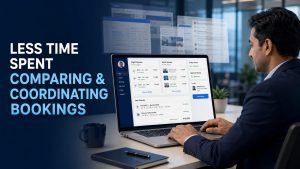
Employees should not have to act as part-time travel coordinators. Searching multiple airline and hotel websites, checking policy limits and sending screenshots for approval can consume time before a trip even begins. A centralized booking process presents relevant, policy-aligned options through one channel and maintains the traveler’s profile, preferences, and itinerary details.
This does not eliminate employee choice. It makes the available choices easier to understand and act on. The result is faster booking with fewer emails, repeated data entries, and avoidable corrections.
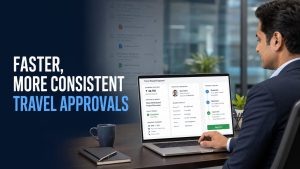
Manual approvals often depend on scattered email threads and incomplete information. A managed travel program can route a request to the appropriate approver with the estimated cost, purpose of travel, and policy status already visible. When approval rules are clear, employees know what they can book and managers can respond faster.
Standardized approvals also improve auditability. Finance teams can trace who requested, reviewed, and approved a trip instead of reconstructing the decision later from messages and attachments.
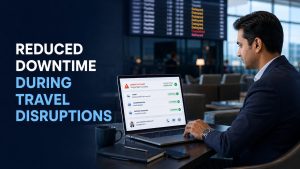
A delay or cancellation is not only a travel inconvenience. It can cause missed meetings, additional costs, and hours of unproductive searching for alternatives. Corporate travel support gives employees a defined point of contact when plans change. Where proactive monitoring is available, the travel team may identify a disruption and begin evaluating options before the traveler has to start from zero.
The real productivity gain is continuity. The employee can focus on communicating with colleagues or clients while trained support handles rebooking, accommodation changes, and revised ground transport.
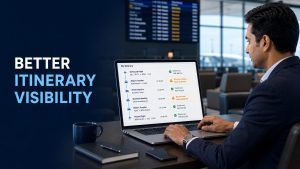
When flight, hotel, transfer, and meeting information sit in different emails and apps, travelers spend unnecessary time locating confirmation numbers and checking timings. A consolidated itinerary makes the journey easier to follow and reduces the risk of missed connections or incorrect pickup details.
Central visibility also helps internal teams support the traveler. If a schedule changes, the travel desk can understand the impact across the complete trip rather than treating each reservation in isolation.
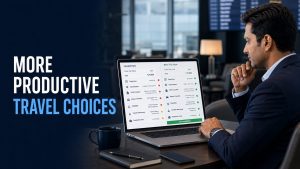
The cheapest itinerary is not always the most economical business decision. A very early departure, a long connection, or a hotel far from the meeting location may reduce the ticket price while increasing fatigue, transfer costs, and lost working time. Corporate travel services help companies evaluate total trip value including schedule, location, flexibility, and traveler well-being, not only the visible fare.
This matters because booking ease and productivity during travel are closely connected with traveler satisfaction. GBTA research on frequent business travelers identified seamless booking and productivity during the journey as important drivers of overall satisfaction.
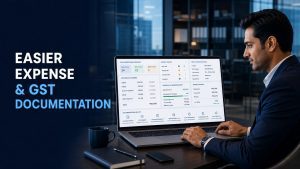
Productivity can also disappear after the employee returns. Missing invoices, incorrect GST details, and unclear expense categories create repeated follow-ups between travellers and finance teams. A structured travel programme can standardise traveller and company information, centralise invoices, and improve the consistency of management reports.
The objective is not merely faster reimbursement. Better documentation reduces administrative work for employees, finance teams, and approvers while improving the organisation’s ability to review travel spend. organisation’s
A strong corporate travel experience gives employees confidence that the organisation has considered their time, safety, and practical needs. This does not require an unlimited travel budget. It requires a programme designed around how people actually travel.
Rigid policies can push employees to book outside approved channels, while completely open booking can reduce visibility and cost control. A better approach gives travellers a reasonable selection of compliant flights, hotels, and transport options. Employees retain agency without having to interpret every rule themselves.
Self-service tools are valuable for straightforward trips, but complex itineraries, visa requirements, group movement, and urgent changes often require experienced support. A hybrid model, efficient technology backed by knowledgeable people, gives travelers speed for routine tasks and reassurance when exceptions arise.
A managed program improves the organization’s ability to know where employees are expected to be and to communicate when a risk or disruption occurs. Travel risk management should include preparation, reliable contact information, escalation processes, and support during an incident. These measures help employees feel supported and help employers respond more consistently.
Traveller profiles can retain practical details such as loyalty memberships, seating preferences, and frequently used routes. Personalisation should operate within company policy and appropriate data-protection practices. Used well, it removes repetitive work and makes frequent travel less tiring to organise.
Employee productivity is only one part of the value. Corporate travel management creates shared benefits across the organisation:
Industry priorities reflect this broader view. In a GBTA outlook poll, travel buyers identified cost control, traveller safety, and return on investment among their leading strategic priorities. A mature programme therefore balances savings with employee well-being and business outcomes.
1. Map the current journey. Document what employees must do from requesting a trip to submitting expenses. Identify repeated steps, delays, and common support issues.
2. Define practical policy rules. Set thresholds and approval paths that are clear enough for employees and managers to follow consistently.
3. Centralise bookings and traveller information. Bring flights, hotels, transfers, and support into a coordinated process wherever possible.
4. Design for disruption. Define who monitors trips, how travellers request help, and how urgent changes are escalated.
5. Measure the traveller experience. Track booking time, approval turnaround, out-of-policy bookings, support resolution, invoice errors, and employee feedback.
6. Review total trip value. Consider productive time, flexibility, location, risk, and traveller wellbeing alongside the fare.
A program cannot improve what it does not measure. Useful indicators include:
Avoid relying on traveller satisfaction or cost savings alone. A program may appear inexpensive while transferring administrative work to employees, or it may feel convenient while producing weak compliance. A balanced scorecard gives a more accurate view.
Technology can simplify travel, but corporate journeys still involve exceptions: last-minute approvals, schedule changes, visa questions, group movement, negotiated requirements, and urgent support. The right travel management company combines efficient systems with experienced people who can take ownership when the standard process is no longer enough.
A well-designed corporate travel program delivers value only when supported by an experienced travel management partner that combines technology, expertise, and responsive service.
Gilpin Travel Management supports organisations with end-to-end corporate travel solutions across air travel, hotels, visas, forex, ground transport, and MICE. With more than 25 years of experience, 200+ travel professionals across eight Indian cities, IATA accreditation, and RBI authorization, Gilpin helps businesses bring greater structure, visibility, and responsive support to employee travel.
Corporate travel services improve productivity when they give time and attention back to employees. Easier booking, faster approvals, consolidated itineraries, responsive disruption support, and cleaner expense documentation reduce the friction surrounding each journey. At the same time, organizations gain the visibility needed to manage cost, compliance, and traveler safety more effectively.
The goal is not simply to book a flight or hotel. It is to create a travel program in which employees can concentrate on the reason they are traveling and feel supported throughout the journey.
Corporate travel should not be viewed as an administrative necessity but as an enabler of business performance. When travel is managed efficiently, employees spend less time navigating logistics and more time delivering business outcomes.
Speak with Gilpin Travel Management to build a smarter, more efficient travel programme that improves visibility, compliance, traveller experience, and business performance.
They reduce the time employees spend searching, coordinating approvals, resolving disruptions, and organising travel documentation. Centralised support lets travellers focus more on meetings, clients, and business outcomes.
Regular booking generally focuses on an individual reservation. Corporate travel management connects bookings with company policy, approvals, traveller support, safety processes, reporting, and expense documentation.
Yes, when it provides a reasonable choice, simple booking, clear policies, responsive assistance, and appropriate consideration for schedule, safety, and well-being. A restrictive or poorly supported program can have the opposite effect.
Companies cannot prevent every cancellation or delay, but they can reduce the impact through itinerary monitoring, clear support channels, flexible booking decisions, and defined escalation procedures.
Gilpin simplifies bookings, compliance and last-minute changes with seamless coordination and reliable support.
Looks like you’ve been inactive for a while.
Discover more about Gilpin Travel Management and explore our services today!
Please take a minute to share your thoughts on our website.
Your input helps us improve and serve you better.
How easy was it to find the information you were looking for?
How would you rate the overall look and feel of the website?
Was the information on the site clear and useful?
How was your browsing experience?
What’s one thing we could improve to make your experience better?
Thank you for taking the time to share your thoughts.
Every suggestion helps us make your experience better.
Your details have been successfully submitted. Thanks!
Gilpin — a trusted corporate travel partner for over 25 years, offering compliant, cost-efficient, innovative, customized, technology-driven, and sustainable corporate travel experiences across India and worldwide.
![]()
![]()
![]()
![]()
![]()