Comparable fares and services can be provided by two corporate travel management companies. The real difference often emerges when plans change, a flight gets canceled late at night, a visa is delayed, or an older traveller needs an urgent alternative.
This is why companies should evaluate a travel management partner on more than fares alone. Service quality, accountability, technology, traveller support, and the ability to manage disruption can have a much greater impact on the overall value delivered.
India has now become one of the largest business travel markets in the world. India is ranked eighth globally with a business travel spend of approximately US$46.9 billion in the 2026 GBTA Business Travel Index. As travel volumes grow, companies require more control around cost, traveller safety, compliance, and support.
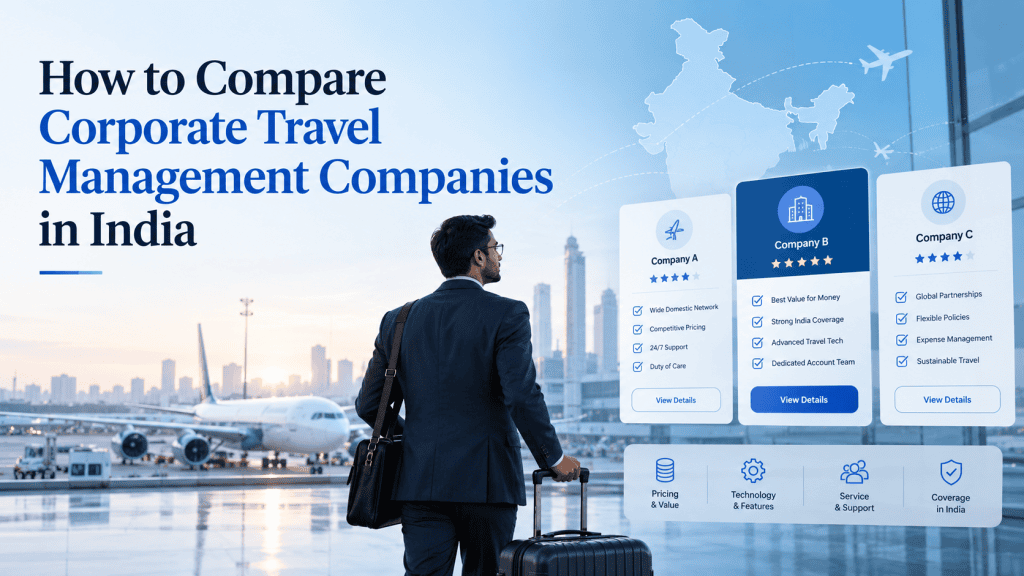
Here are 10 practical criteria to compare corporate travel management companies in India.
1. End-to-End Travel Capability
Don’t just consider air ticketing.
A good travel management company should be able to handle flights, hotels, ground transport, visas, forex, travel insurance, and MICE requirements.
Ask which services are managed directly and who is responsible if multiple services are involved.
2. 24/7 Support That Actually Works
Most TMCs claim to provide 24/7 support.Give it a go.
Ring the support line out of hours and see how fast the team can access a booking, understand the issue, and suggest a workable solution.
Don’t rely on a 24/7 support claim alone. Test the service outside office hours and assess how quickly the team can access a booking, understand the issue, communicate the available options, and resolve the problem. The key question is not simply whether someone answers the call, but whether the team can take ownership and provide an effective solution.
3. Strong Supplier Access
Supplier access is about more than price. Strong airline and hotel relationships can improve availability, flexibility, and negotiated value, particularly during peak travel periods, major conferences and disruptions.
They can enhance availability in peak travel periods, exhibitions, major conferences, and disruptions.
Compare prices, flexibility, cancellation policies, hotel location, inclusions, and availability.
4. Spend Visibility and Policy Control
A mature travel programme should provide finance and travel teams with visibility into where money is being spent.
Request reports broken down by traveller, department, route, airline, hotel, and cost center.
Check whether out-of-policy bookings are flagged before ticketing or are only in a report afterward.
5. Technology That Fits Your Employees
Many Indian companies now use online platforms for travel booking and expense management, but not every journey should be fully self-serviced.
But not every journey should be self-serviced.
Simple domestic trips may work well online; complex international travel may require assisted booking.
The right partner should support both.
6. Duty of Care and Traveller Safety
Traveller tracking is just one element of the duty of care.
A good provider should be able to spot affected travellers during disruptions, communicate with them, and quickly coordinate alternatives.
Ask about emergency escalation processes, destination risk support, and protocols for higher-risk travel situations.
7. Visa, Documentation, and Forex Support
Visa timelines can make or break an entire trip for international travellers.
Check if country-specific document guidance, pre-submission checks and escalation support are provided by the provider.
For forex too, companies should ensure that services are provided through suitably authorized channels as per RBI regulations.
8. Reliable Ground Transport
Flights and hotels get most of the attention, but ground transport can make or break a business trip.
Find out what the vetting process for drivers and vendors is, how delays are handled and what happens if a vehicle doesn’t show up.
If sustainability is important to your organisation, look for EV options.
9. MICE and Group Travel Capability
A leadership offsite or dealer conference is a different skill set than an individual business trip.
Experience in venue sourcing, group air travel, rooming lists, transfers, attendee coordination, and on-ground support.
Request a recent case study similar to your requirement.
10. Experience You Can Verify
Years in business is good, but references are better.
Talk to your current corporate clients and ask one simple question:
“What happens if something goes wrong?”
How a provider manages a disruption can tell you more than a list of awards or claims.
A Shortlist Comparison Made Simple
Use a weighted score card.
Score each provider on a scale of 1 to 5 on each of the ten criteria based on evidence not presentations.
Then do some live tests:
- See the same sample itinerary
- Test after hours support
- MIS report review sample
- Run a disruption scenario
- Talk to references of the client.
Consider a short pilot before full launch.
This way you get a better idea of quality of service before committing to a long-term contract.
Where Gilpin Travel Fits In
Gilpin Travel Management has been operating since 1998 and provides corporate travel services across flights, hotels, visas, forex, ground transportation, and MICE.
Gilpin supports more than 200 corporate clients, operates across eight Indian cities, and provides 24/7 traveller assistance.
The company also states that it is IATA accredited, ISO 9001 certified, and RBI authorized as an AD-II foreign-exchange dealer.
For companies evaluating travel partners, these capabilities are relevant because they bring multiple parts of business travel under one managed framework. This can help organisations simplify vendor coordination, improve accountability, and establish single-point ownership across corporate travel requirements from bookings and traveller support to visas, forex, ground transport, reporting, and disruption management.
That said, Gilpin should be evaluated using the same process as every other provider: Test the service, review the reporting, speak to references, and measure performance against your organisation’s needs.
Conclusion
The best corporate travel management company is not necessarily the one with the lowest fare.
It is the one that gives your business the best combination of cost control, traveller support, visibility, compliance, and accountability.
When comparing corporate travel management companies in India, focus on how well each provider performs before, during, and after the trip.
Because when everything goes according to plan, many travel companies look similar.
The difference becomes clear when the plan changes.