

Business Class Flight Booking in India How to Get the Best Fares for Corporate Travel

Business Class Flight Booking in India: How Corporates Can Get Better Fares and Smarter Travel Outcomes

Business class travel is becoming an important part of corporate travel planning in India. For many companies, it is no longer seen only as a premium travel choice. It is often linked to productivity, senior leadership travel, long-haul meetings, investor discussions, international conferences, urgent business travel and employee experience.

The real question for companies is not just whether business class is expensive. The more practical question is whether the trip justifies the cost.

A business class ticket can make sense when the traveller needs to arrive rested, prepared and ready for an important meeting. It can also support better schedule control, faster airport movement, improved baggage handling, flexible itinerary changes and better overall traveller comfort.

For Indian companies, the best way to manage business class flight booking is to plan early, compare more than just the visible online fare, understand fare rules, follow corporate travel policy, check GST documentation and coordinate supporting requirements such as visa, forex, travel insurance and hotel bookings in one structured process.

This is where a corporate travel partner like Gilpin Travel Management can help companies look beyond ticket price and manage the complete business travel journey with better control.

When Business Class Becomes a Business Decision

When Business Class Becomes a Business Decision

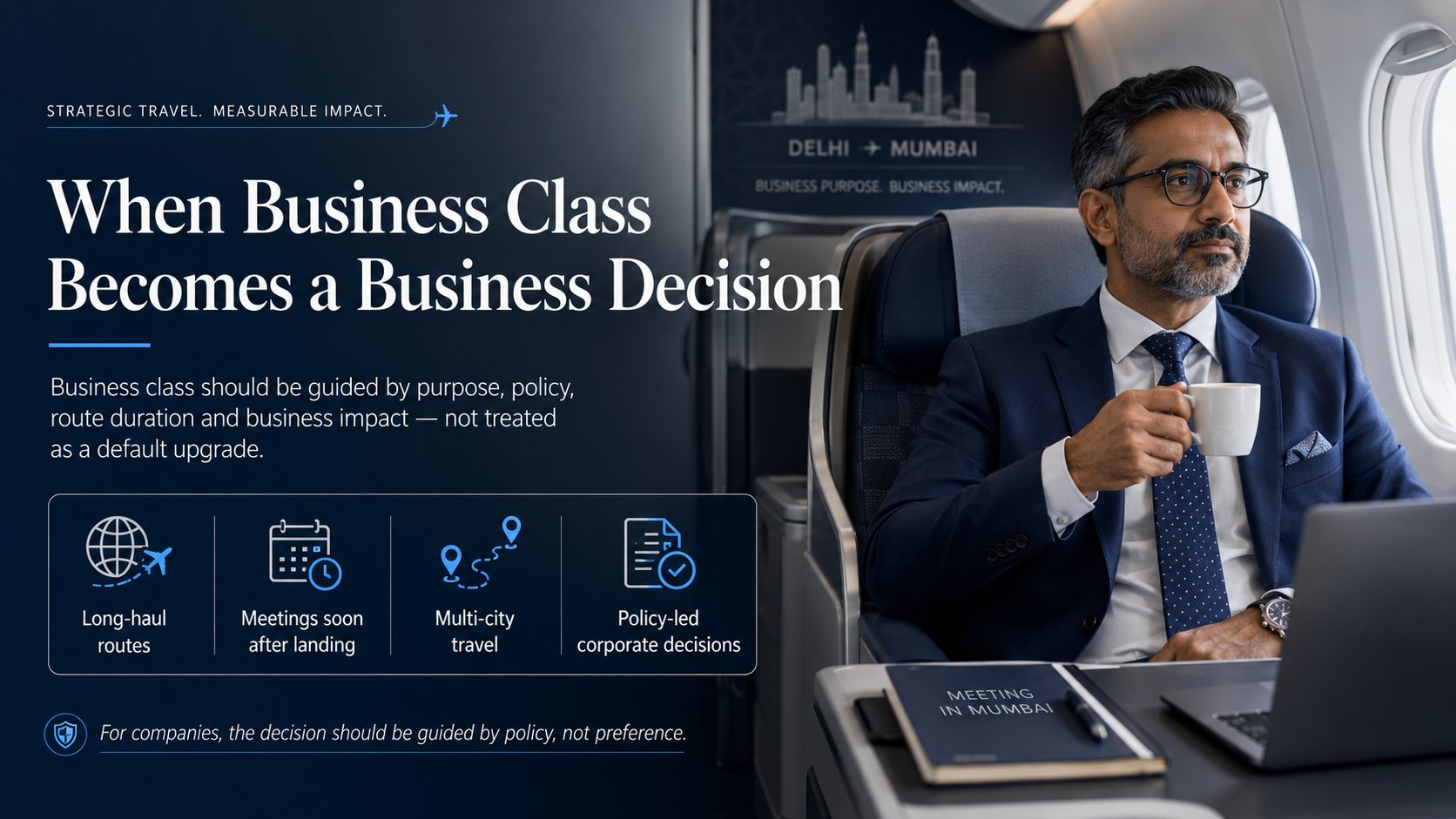
Business class should not be treated as a default upgrade. It should be linked to the purpose of the trip, traveller profile, route duration and business impact.

For senior management, CXOs, board members, legal teams, sales leaders, project heads and employees attending high-value meetings, business class can support better productivity and preparedness. A long-haul economy flight may reduce ticket cost, but it can also affect rest, focus, recovery time and meeting performance.

Business class may be a practical decision when:

  • The flight duration is more than 6 to 8 hours.
  • The traveller has a meeting soon after landing.
  • The trip involves multiple cities in a short period.
  • The traveller is carrying important business documents or equipment.
  • The itinerary may require last-minute changes.
  • The company policy allows premium cabin travel for certain grades or route durations.

The trip involves client meetings, investor discussions, legal matters, exhibitions, conferences or MICE movements.

For companies, the decision should be guided by policy, not preference. A clear business travel policy helps define who is eligible for business class, on which routes, under what conditions and with what approval process.

Why Timing Matters in Business Class Flight Booking

Business class fares are highly sensitive to timing, airline inventory, route demand, seasonality, fare class availability and cancellation flexibility.

For corporate travel, timing becomes even more important because companies also need to manage approvals, visa timelines, internal budgets, traveller availability, meeting schedules and finance documentation.

As a working benchmark:

  • Domestic business class travel should ideally be checked 2 to 4 weeks in advance.
  • Short-haul international business travel should be checked 6 to 8 weeks in advance.
  • Long-haul international business travel should be checked 8 to 12 weeks in advance.
  • Travel linked to exhibitions, conferences, peak seasons and large events should be planned 3 to 6 months in advance.

Early planning does not only help with fare discovery. It gives the travel desk more options across airlines, routes, layovers, fare families, cancellation rules and upgrade possibilities.

For example, a direct flight may be ideal for a senior leader with a tight schedule, while a one-stop route may work better when the company wants to balance comfort and cost. Similarly, a flexible fare may be more valuable than a cheaper restrictive fare if the meeting date is likely to change.

Business class demand from Indian corporates continues to be strongest on routes connecting Mumbai, Delhi, Bengaluru, Hyderabad and Chennai with major global business centres. These cities remain key gateways for international business travel, conferences, client meetings, investment discussions and project-related travel.
Corporate Fares vs Public Fares

Corporate Fares vs Public Fares

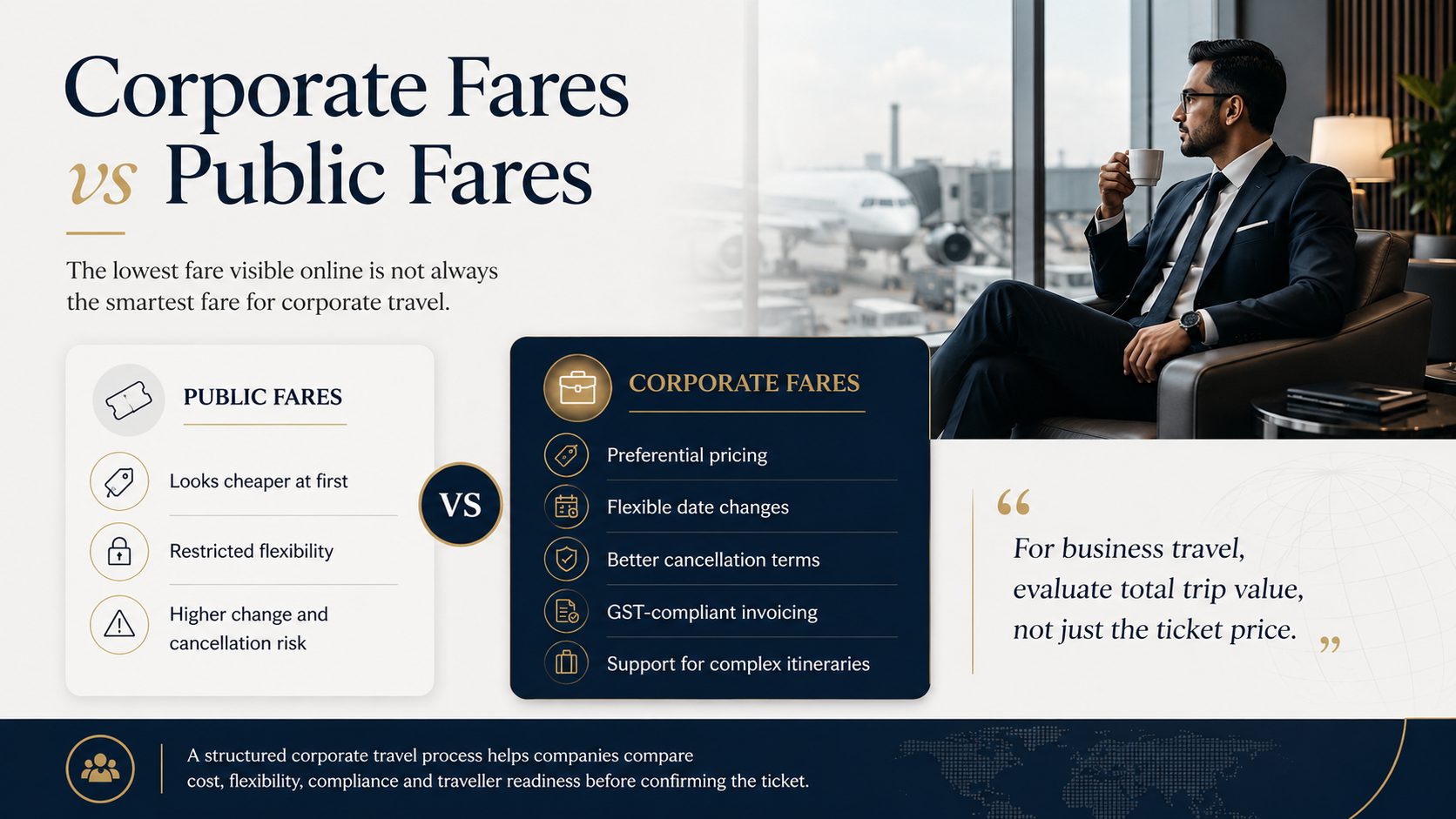
The lowest fare visible online is not always the best fare for corporate travel.

Public fares may look attractive at first, but they often come with restrictions that can increase the total cost if plans change. A cheaper ticket may have limited cancellation value, high date-change penalties or poor flexibility.

Corporate negotiated fares can offer better overall value through:

  • Preferential airline pricing
  • Flexible date-change options
  • Better cancellation terms
  • Access to suitable fare buckets
  • Policy-based approvals
  • Company-level reporting
  • GST-compliant invoicing
  • Traveller assistance during delays or disruptions
  • Support for multi-city and complex itineraries

For business class, the smarter approach is to evaluate the total trip value, not just the ticket price. This includes schedule convenience, arrival time, meeting readiness, baggage allowance, lounge access, visa status, GST documentation and policy compliance.

A structured corporate travel management process helps companies compare these factors before confirming the ticket.

How Companies Can Optimise Business Class Fares

1. Do not wait until the last week

Last-minute business class fares can be significantly higher, especially on high-demand routes from India to business hubs such as London, Dubai, Singapore, New York, Frankfurt and Hong Kong.

If the meeting is confirmed, companies should start comparing fare options early. Even if the final approval comes later, early fare checks help the travel desk understand pricing patterns and availability.

2. Compare direct and one-stop routes

Direct flights save time and reduce travel fatigue. However, one-stop options through hubs such as Dubai, Doha, Abu Dhabi, Singapore, Istanbul or Frankfurt may sometimes offer better business class value.

The right choice depends on the traveller’s schedule, meeting time, connection comfort and company policy. For senior travellers, the cheapest option may not always be the most practical option.

3. Use flexible travel dates where possible

A one-day shift in departure or return can create a meaningful fare difference. For meetings that are not fixed to one date, the travel desk should compare nearby dates before booking.

4. Check alternate airports

Some destinations have multiple airport options. For example, a traveller going to New York may compare JFK and Newark. A traveller going to London may compare Heathrow and Gatwick depending on the airline, onward location and meeting schedule.

This can help companies find better route combinations without compromising traveller convenience.

5. Review fare rules before booking

A cheaper business class ticket may have strict cancellation or reissue conditions. For corporate travel, flexibility is often more valuable than a small fare saving.

Before confirming the booking, companies should check:

  • Cancellation charges
  • Date-change fee
  • Refund rules
  • No-show conditions
  • Fare validity
  • Baggage allowance
  • Upgrade eligibility
  • Lounge access
  • Rebooking support

6. Use airline loyalty intelligently

Frequent corporate travellers can benefit from airline miles, status benefits, lounge access, priority services and possible upgrades. Companies should track these benefits properly, especially for repeat routes and senior leadership travel.

7. Consider mixed-cabin itineraries

For some trips, companies may choose business class for the long-haul sector and economy or premium economy for short connecting sectors. This can help control cost while protecting comfort on the most demanding part of the journey.

8. Avoid risky booking shortcuts

Hidden-city ticketing, duplicate bookings, unofficial fare tricks and policy loopholes can create operational, legal and compliance issues. Corporate travel should remain clean, auditable and policy-compliant.

The Role of Travel Policy in Business Class Booking

A strong corporate travel policy helps companies avoid subjective decisions.

Instead of approving business class on a case-by-case basis, companies can define clear rules based on:

  • Employee grade
  • Flight duration
  • Domestic or international sector
  • Meeting importance
  • Client-facing travel
  • Overnight travel
  • Red-eye flights
  • Medical or accessibility needs
  • Budget limits
  • Approval hierarchy
  • Business outcome

For example, a company may allow business class for CXOs on all international sectors, senior leaders on flights above 6 hours, and project teams only when travel is linked to critical client meetings or MICE movements.

This helps admin, HR and finance teams make faster, more consistent decisions. It also improves employee experience because travellers know what they are eligible for before the booking process begins.
Productivity and Traveller Experience Matter

Productivity and Traveller Experience Matter

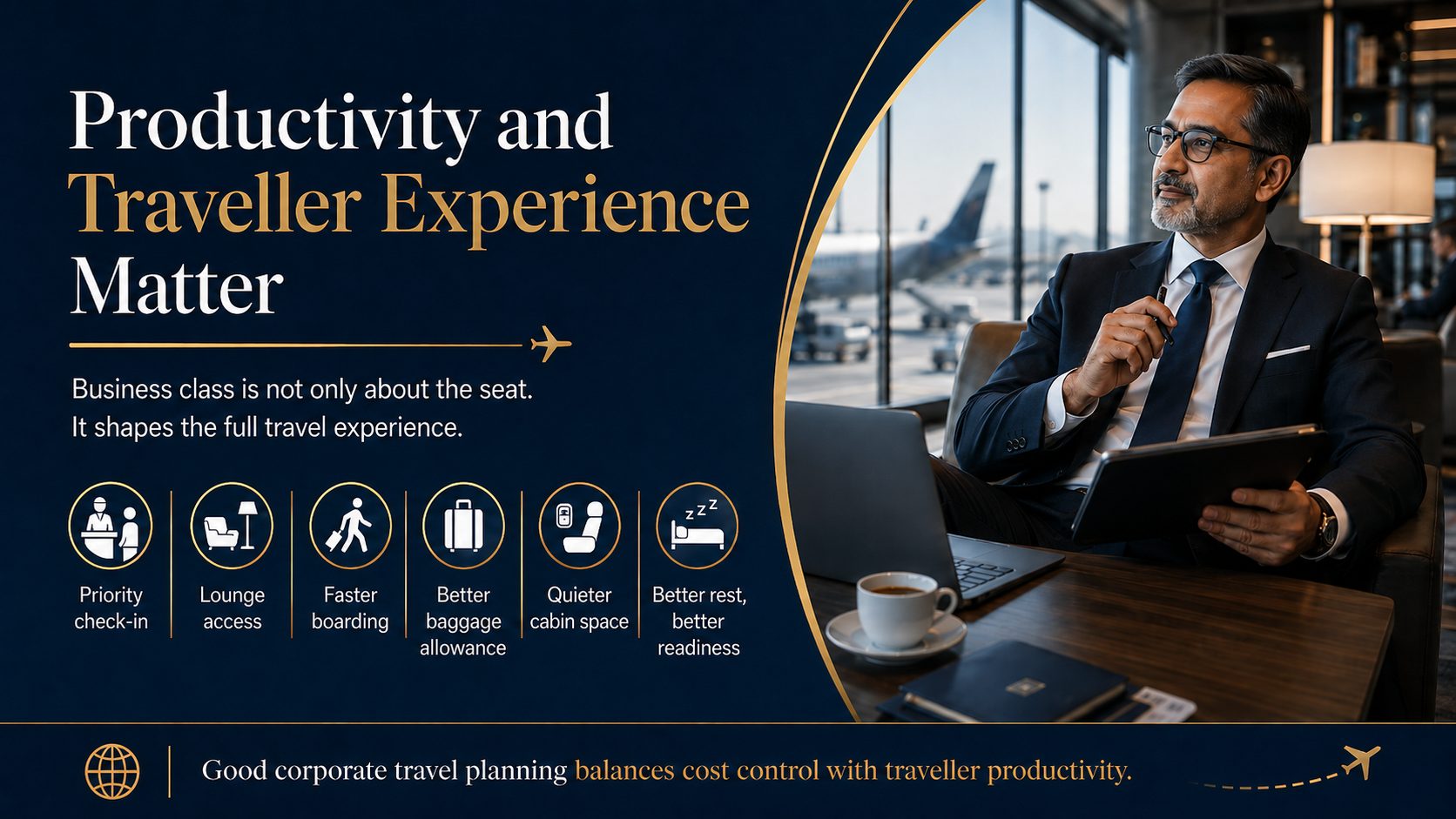
Business class is not only about the seat. It also affects the complete travel experience.

Priority check-in, lounge access, faster boarding, better baggage allowance, quieter cabin space and more comfortable rest can all reduce travel friction. For business travellers, this matters because the journey often continues immediately after landing.

A senior executive may need to attend a board meeting. A sales leader may need to present to a client. A project head may need to visit a site. A legal team may need to reach a hearing or negotiation. In these situations, comfort directly supports readiness.

Good corporate travel planning should balance cost control with traveller productivity. A lower fare is not always better if it affects the traveller’s ability to perform.

GST-Compliant Business Class Booking

For Indian companies, GST documentation is an important part of corporate flight booking.

A business class ticket may be booked correctly from a travel perspective, but if the GST details are missing or incorrect, the finance team may face reconciliation issues later.

Before confirming the ticket, companies should ensure:

  • The correct company GST number is entered at the time of booking.
  • The invoice carries the correct legal entity name.
  • The ticket is booked for business use.
  • GST details are available for finance records.
  • Cancellation or reissue documentation is maintained.
  • Monthly MIS and reconciliation support is available.

As GST rules can change, companies should always verify the latest GST treatment, applicable rates, and input tax credit eligibility with their finance or tax team before making claims. Also make sure that your travel agency will provide you airline G.S.T. invoices.

Visa, Forex and Insurance Should Support the Flight Booking Journey

For international business class travel, flight booking should not happen in isolation.

Visa timelines, forex requirements, travel insurance, hotel details, and business documentation can directly affect the final travel plan. If a company books a restrictive fare before checking visa readiness, it may face change penalties or cancellation costs later.

This is why supporting services should be integrated into the booking journey.

Visa support helps confirm documentation, appointment availability, business invitation letters and destination requirements before the ticket is finalised.

Forex support helps business travellers manage international expenses, currency requirements, prepaid cards and compliant foreign exchange transactions.

Travel insurance helps protect the company and traveller against medical emergencies, delays, cancellations and other travel-related risks.

These services should complement business class booking rather than distract from it. The main goal remains better flight planning, fare optimisation, policy control and traveller readiness.

Business Class for MICE and Group Travel

Business class booking is also relevant in MICE travel, especially when senior leaders, speakers, clients, investors or international guests are travelling for a corporate event, conference, incentive programme or board-level gathering.

In such cases, the travel desk may need to manage multiple traveller categories. Some employees may travel economy, senior leaders may travel business class, and international guests may need special support across flights, hotels, transfers, visas and schedule changes.

This requires more than simple ticketing. It needs route planning, group coordination, fare control, traveller segmentation and real-time assistance.

Business Class Booking Checklist for Indian Companies

Before confirming a business class ticket, companies should check:

  • Traveller name as per passport
  • Passport validity
  • Destination visa requirement
  • Business invitation letter, if applicable
  • Internal travel approval
  • Travel policy eligibility
  • Preferred airline or alliance
  • Direct versus one-stop route
  • Fare cancellation rules
  • Change fee and refund policy
  • Baggage allowance
  • Lounge access
  • Arrival time before meeting
  • GST details and company billing
  • Forex requirement
  • Travel insurance requirement
  • Hotel and airport transfer needs
  • Emergency contact and 24/7 support

This checklist helps reduce errors and gives admin, HR, finance and travellers a smoother process.

Why Book Business Class Flights Through Gilpin Travel Management?

Business class travel should not be treated like a simple online transaction. For corporates, the booking must support cost control, policy compliance, documentation, traveller comfort and business continuity.

Gilpin Travel Management helps companies manage business class flight booking through a more structured process. This includes domestic and international air ticketing, fare comparison, cabin-class options, multi-city itineraries, GST-compliant invoicing, visa coordination, forex support, travel insurance, MICE travel and 24/7 traveller assistance.

For companies that want better visibility and fewer fragmented travel processes, Gilpin Travel brings flights and supporting services into one coordinated travel management system.

Conclusion

The best business class flight booking in India is not only about finding a cheaper ticket. It is about finding the right fare at the right time, with the right flexibility, policy approval, GST documentation, and traveller support.

For Indian companies, business class can be a smart business decision when the trip involves senior leadership, long-haul travel, high-value meetings, tight schedules, international commitments, or MICE movements.

The smartest approach is to plan early, compare beyond public fares, review fare rules, follow corporate travel policy, check visa readiness, protect flexibility, capture GST details correctly, and work with a corporate travel partner that understands business travel.

Looking to optimise business class travel while maintaining policy compliance, traveller comfort and cost control? Connect with Gilpin Travel Management for structured corporate travel support.

FAQs

1. What is the best time to book business class flights from India?

For planned international corporate travel, companies should usually start checking fares 6 to 10 weeks in advance. For long-haul routes, trade fairs, conferences, peak seasons and multi-city trips, 3 to 6 months of advance planning can give better flexibility.

2. Are corporate business class fares always cheaper than public fares?

Not always. Corporate fares may not always be lower than public fares, but they can offer better overall value through flexibility, reporting, policy compliance, GST documentation, cancellation support and traveller assistance.

3. When should a company approve business class travel?

Business class may be approved when the traveller is senior, the flight is long-haul, the meeting is high-value, the traveller needs to work soon after landing, or the company travel policy allows premium cabin travel based on route duration or employee grade.

4. Why is GST documentation important for business class booking?

GST documentation helps finance teams manage compliance, reporting and reconciliation. Companies should ensure the correct GST number, legal entity details and invoice records are captured at the time of booking.

5. Should visa support be checked before booking business class flights?

Yes. For international business travel, visa timelines should be checked before booking restrictive fares. This helps reduce the risk of cancellation charges or reissue penalties if visa appointments, documents or approvals are delayed.

6. Does Gilpin support business class flight booking for corporate travel?

Yes. Gilpin Travel Management supports corporate air ticketing, business class flight booking, fare comparison, multi-city travel, visa coordination, GST-compliant invoicing, forex, travel insurance and 24/7 traveller assistance.

×

Still with us?  

Looks like you’ve been inactive for a while.
Discover more about Gilpin Travel Management and explore our services today!

Explore Services

We would love to hear from you!

Please take a minute to share your thoughts on our website.
Your input helps us improve and serve you better.

Ease of Use

How easy was it to find the information you were looking for?

Design & Visuals

How would you rate the overall look and feel of the website?

Content Clarity

Was the information on the site clear and useful?

Performance

How was your browsing experience?

Email

Suggestions

What’s one thing we could improve to make your experience better?

Thank you for taking the time to share your thoughts.
Every suggestion helps us make your experience better.

Register with us Request a demo