
September 3, 2026


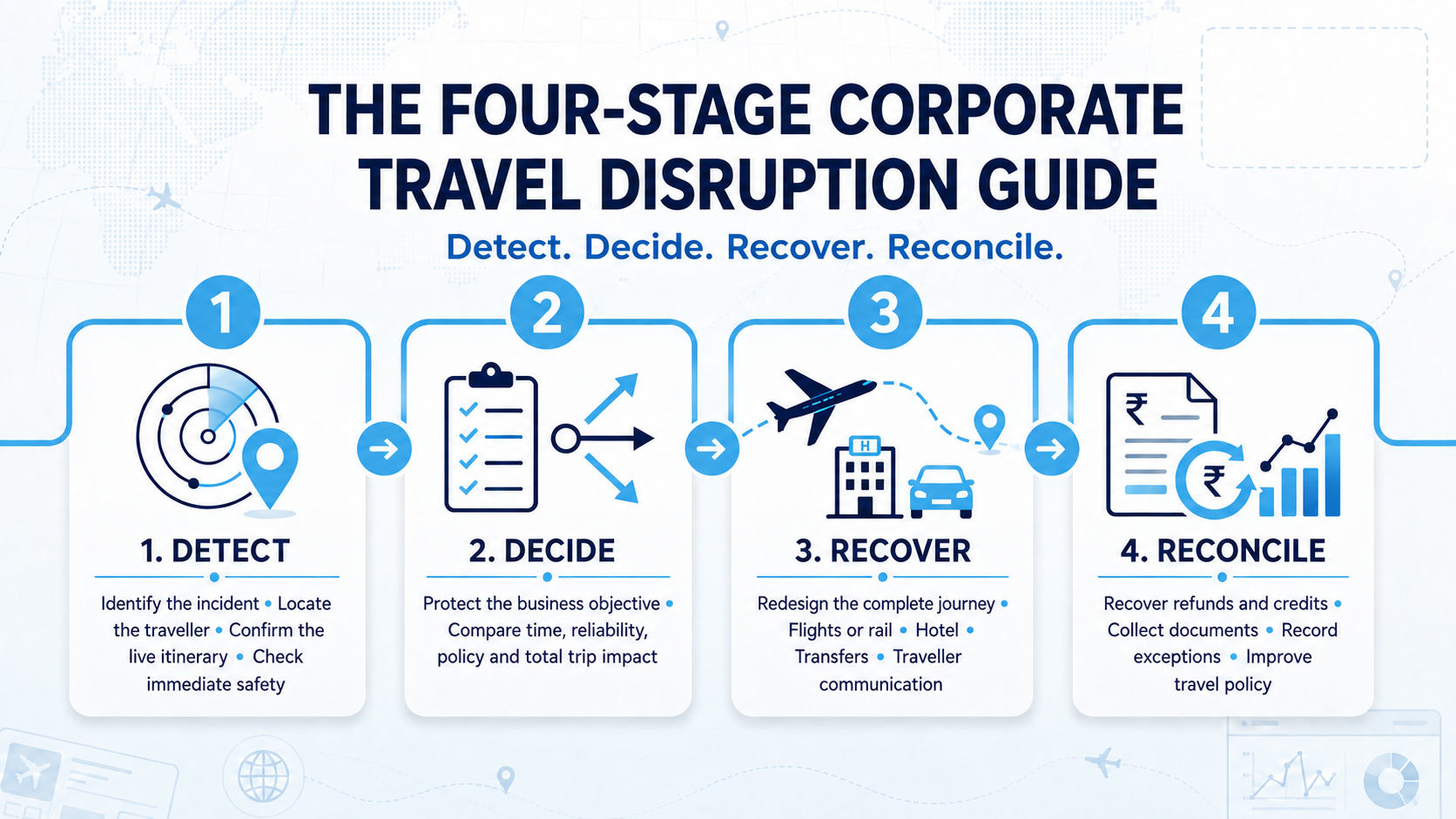
A useful guide can be organized into four stages: detect, decide, recover, and reconcile.
Locate the impacted traveler, confirm the live itinerary, assess for current safety issue and identify the incident.
Protect the business objective. Compare the available options based on arrival time, reliability, policy, traveler condition, and total trip impact, not just ticket price.
Rebook or redesign the whole trip: flights or rail, hotel, transfers, visa or insurance implications, and meeting communication.
Collect invoices and credit notes, record exceptions, review the cause, improve the policy, and recover refunds and credits.
Most disruption failures begin before the journey. The company may not have complete traveler contact details, bookings may be split across websites, emergency approvals may be unclear, and no one may know who is responsible after office hours. The following controls make a faster response possible.
Flights, hotels, and transfers booked through unrelated channels create blind spots. A core travel record should include the traveler’s correct mobile number and email address, full itinerary, ticket and fare rules, hotel cancellation terms, ground transport details, approving manager, and emergency contact. Accurate contact details are also key under Indian airline passenger rules, as airlines and travel agents need this to communicate operational changes.
The traveler should know one main contact person. Internally, the company should identify the travel desk, after-hours approver, and escalation owner for safety, medical, or group incidents. Responsibility should be a function of severity, not title.
With seats disappearing, waiting for a senior approver adds cost and disruption time. For example, policies need to define which team can approve reasonable fare increases, emergency hotels, replacement transfers, or out-of-policy options and what documentation is needed afterward.
For business-critical trips, compare flexible and restricted fare rules, sensible connection times, alternate airports, early and late departures, rail or road alternatives where practical, and the cost of arriving one day earlier. The objective is not to overpay for every trip; it is to know where resilience is worth purchasing.
The flight is only part of the trip. Hotel check-in, airport transfers, local cars, visa validity, forex needs, travel insurance, meeting schedules, return travel, and all related requirements need to be included. Otherwise, a single successful rebooking can leave a number of costs unresolved.
Employees should know whom to contact, what information to share, when they may self-book, which emergency expenses are permitted, how to preserve receipts, and what to do when there is a personal safety or medical concern.
A sample incident structure is shown below. It is an operating example, not a legal classification; every company should adapt it to its routes, traveler population, and risk profile.
Level | Typical situation | Primary owner | Immediate objective |
|---|---|---|---|
Level 1 | Routine delay with no missed connection or safety concern | Travel desk | Monitor, inform, and protect downstream bookings. |
Level 2 | Cancellation, missed connection, overnight delay, or meeting risk | Travel desk + approving manager | Compare options and recover the complete itinerary. |
Level 3 | Medical, safety, security, or multi-traveler incident | Incident lead + HR/leadership | Locate, protect, communicate, and escalate specialist support. |
Practical next step: Select any one of the disruptions from the last 90 days and reconstruct the timeline. How long did it take to reach the traveler, approve an option, confirm the full replacement itinerary, and close the refund? If several employees or suppliers have to chase the same information, the process needs a single point of coordination.
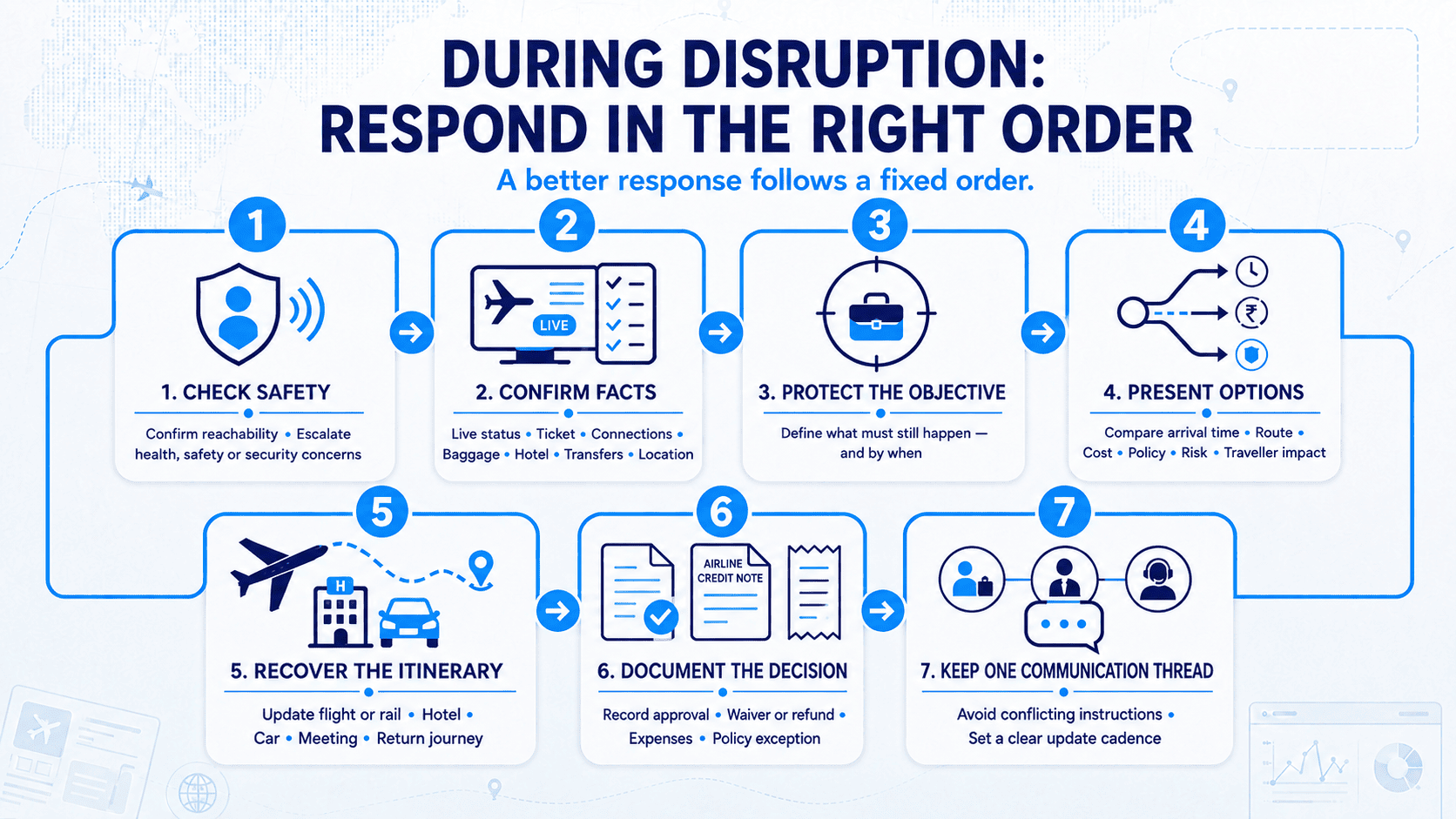 When an incident is active, teams often start by searching for another ticket. That can be premature. A better response follows a fixed order.
Companies should also set practical response targets, for example, acknowledgement within a defined number of minutes and a clear update cadence, but those targets must reflect staffing, route complexity, and the seriousness of the incident. They should not be presented as guaranteed recovery times.
India’s Directorate General of Civil Aviation publishes a Civil Aviation Requirement covering denied boarding, flight cancellations, and delays. The version reviewed for this article is CAR Section 3, Series M, Part IV, Revision 4 dated 25 January 2023. Companies should verify the live DGCA publication and the operating airline’s policy before relying on any entitlement.
Important: Passenger-rights information is included for operational awareness and is not legal advice. Rules, airline policies, and facts change. Check the latest DGCA and airline publications for each incident.
The incident is not finished when the traveler reaches the destination. Finance and travel teams still need a controlled closure process.
This is where a disruption Guide becomes a management system rather than an emergency checklist. Each incident produces evidence that can improve fare choices, booking channels, preferred hotels, transfer planning, approval limits, and traveler communication.
An employee is booked on an evening flight from Bengaluru to Mumbai for a 9:30 a.m. client review the following day. After the employee checks in, the flight is cancelled. The hotel and airport transfer in Mumbai are already confirmed, but no accommodation has been arranged in Bengaluru for that night.
Without a clear disruption management guide, the employee may be left to queue at the airline counter, search across multiple booking platforms, purchase the first available and potentially expensive—alternative, update the client personally, and later submit several disconnected reimbursement claims.
With the guide in place, the travel desk begins by confirming that the employee is safe and reachable. It then reviews the airline’s alternative flight options, along with the applicable refund and waiver conditions. The team compares the next available flight that evening, the earliest departure the following morning, and any practical connecting routes.
Based on these options, the business owner decides whether the employee must arrive before the meeting or can join remotely at first and attend in person later. Once an option is selected within the company’s emergency approval limits, the travel desk confirms the revised itinerary, coordinates any necessary changes to the Mumbai hotel and airport transfer, and arranges accommodation in Bengaluru if required. A single, consolidated update is then shared with both the employee and the meeting owner.
After the immediate disruption has been resolved, the travel desk records and follows up on the airline refund or credit note, supporting invoices, and GST documentation until the case is formally closed.
The Guide cannot guarantee that the original meeting will proceed exactly as planned. However, it ensures that the company reaches a fast, informed, and documented decision without leaving the employee to manage the disruption alone.
Travel teams should measure outcomes that reflect recovery quality, not only the number of incidents.
These measures help finance understand the true cost of disruption, help HR assess traveler support, and help admin or procurement identify the policy changes that will reduce future friction.
The travel partner can see and manage more than the airline ticket. And that makes managing a disruption easier.” Gilpin Travel Management provides Indian companies a centralized human-backed travel service model, including air ticketing, hotels, cars, rail, bus, visas, forex, travel insurance, and airline GST services.
Gilpin’s official service information says it offers 24/7 customer support, real-time flight alerts, assistance with changes and cancellations, and coordinates alternative arrangements subject to the rules of the airline or railroad and availability. The company has been in India since 1998 and has offices in all major Indian business cities.
This gives a clear support pathway for HR and travelers. It reduces the need for admin teams to manage several suppliers at the same time of the incident. Centralized booking and documentation can make it easier to track emergency costs, refunds, credits, and GST records for finance. A managed process provides more accountability when an important journey changes unexpectedly for leadership.
Companies that want to strengthen their disruption process can review Gilpin’s corporate air ticketing services, hotel booking support, corporate car rentals, and airline GST compliance services as parts of one coordinated travel program.


Looks like you’ve been inactive for a while.
Discover more about Gilpin Travel Management and explore our services today!
Gilpin — a trusted corporate travel partner for over 25 years, offering compliant, cost-efficient, innovative, customized, technology-driven, and sustainable corporate travel experiences across India and worldwide.


